
For decades, the IT industry has been powered by service companies. Businesses needed websites, applications, and systems, and technology partners built them. The model worked. It scaled. It created global giants.
But the economics of technology are changing. Cloud computing, artificial intelligence, and platform ecosystems are shifting IT from something companies rent to something they own.
The next decade of IT won’t be defined by who delivers the most projects. It will be shaped by who builds products, platforms, and intellectual property that compound in value over time.
The Shift: From Delivery to Ownership
In the service era, success was measured in hours billed, projects completed, and contracts signed. Technology was a tool — important, but ultimately replaceable.
In the product era, success is measured in users, engagement, data, and compounding value. Technology becomes an asset. A platform doesn’t just serve a business — it becomes the business.
Look at how the world’s most valuable companies operate today. They don’t sell effort. They sell ecosystems.
- A marketplace doesn’t just connect buyers and sellers — it owns the network.
- A SaaS platform doesn’t just solve a problem — it becomes the standard.
- A fintech product doesn’t just process transactions — it becomes part of the financial infrastructure.
This is the future IT is moving toward: technology as capital, not cost.
Why Services Alone Can’t Win the Long Game
Service models are inherently linear. Growth depends on adding more people, more projects, and more hours. That makes scaling expensive, complex, and fragile.
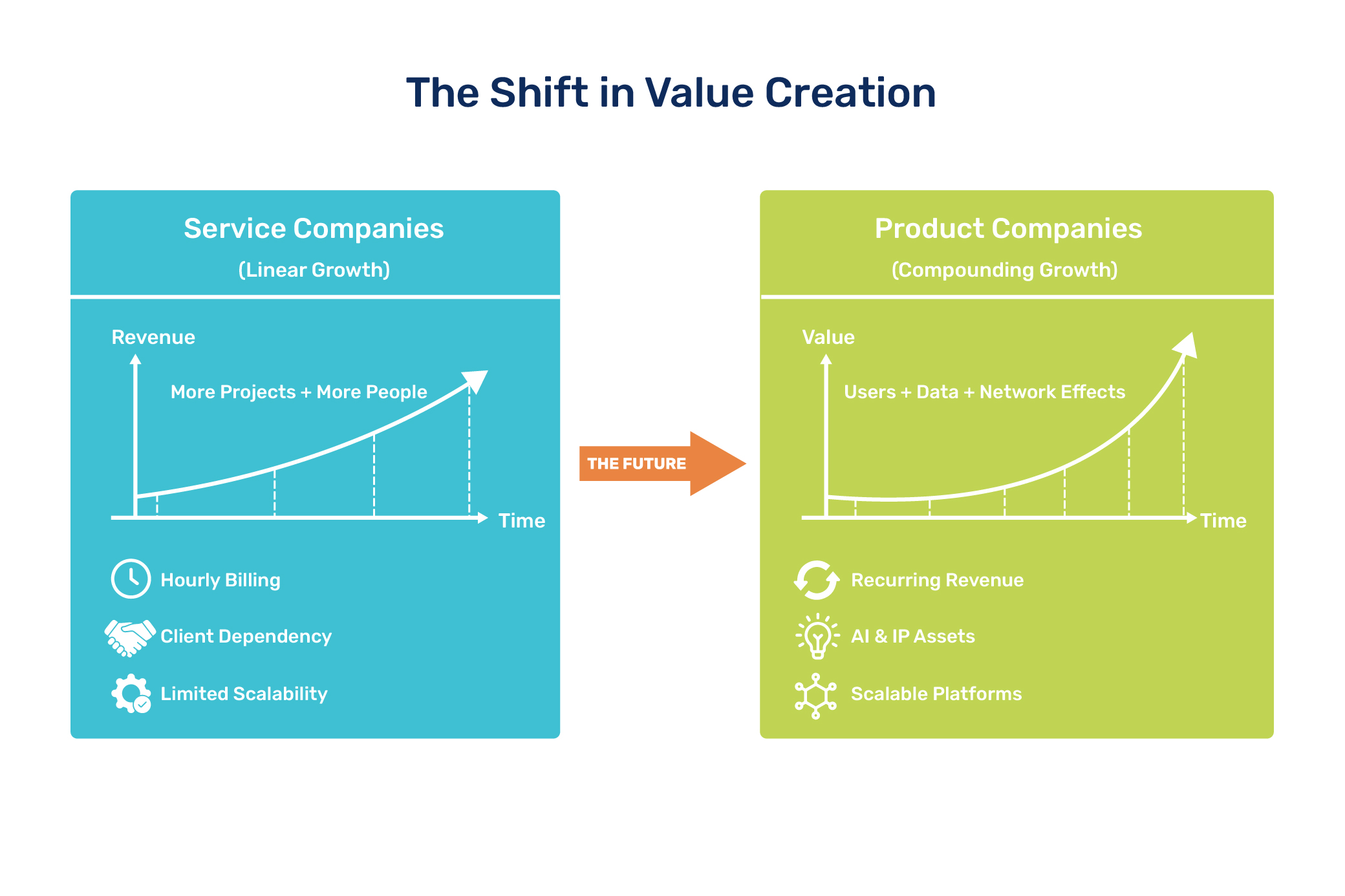
Products scale differently. A well-built platform can serve 10 users or 10 million with the same core engine. Its value grows as adoption grows. Data compounds. Network effects kick in. Over time, the product becomes harder to replace and more deeply embedded in its users’ workflows.
In a world driven by AI and automation, this difference becomes even more pronounced. AI doesn’t just speed up development — it amplifies products. The more a product is used, the smarter it becomes. The smarter it becomes, the more valuable it gets. This creates a flywheel that service-based models simply can’t replicate.
The Rise of the Platform Mindset
The next generation of IT leaders are thinking less like vendors and more like architects of ecosystems.
They ask different questions:
- How can this system evolve on its own?
- How can users shape its future?
- How can data turn into insight, and insight into advantage?
This mindset leads to platforms that are modular, extensible, and intelligent by design. Instead of delivering a finished product and moving on, these companies deliver a living system — one that can grow with its users and adapt to markets that don’t stand still.
AI as the Great Accelerator
Artificial Intelligence is not just a tool for efficiency. It’s a force multiplier for product companies.
In a service model, AI helps teams work faster.
In a product model, AI helps systems think, learn, and improve.
That’s a fundamental difference.
AI-powered products can personalize experiences, predict behavior, automate decisions, and surface insights in real time. Over time, they become less like software and more like digital partners. This is where long-term value is created — not in the initial build, but in continuous learning and adaptation.
The companies that win the next decade won’t just deploy AI internally. They will embed intelligence into their products, making it part of the user’s daily workflow.
From Code to Capital
In the past, technology budgets were treated as expenses. Something to be optimized, reduced, or justified.
Today, technology is increasingly treated like an investment — something that increases a company’s valuation, reach, and strategic leverage.
A product with loyal users, proprietary data, and a strong ecosystem becomes digital capital. It attracts partners. It creates switching costs. It opens new revenue streams that go far beyond the original use case.
This is why startups are racing to build platforms instead of projects, and why enterprises are investing heavily in proprietary systems instead of off-the-shelf solutions. Ownership of technology is becoming ownership of market position.
What This Means for the IT Industry
The future IT company won’t be defined by how many developers it has, but by how much intellectual property it owns.
The most successful firms will likely operate in a hybrid world:
- Still delivering services to stay close to real-world problems.
- But continuously turning insights from those problems into products, frameworks, and platforms.
This creates a powerful loop:
Client challenges → Product ideas → Platforms → Industry standards.
Over time, these companies stop competing on price and start competing on vision, capability, and influence.
Where Thirtyfour® Fits In
At Thirtyfour®, our journey began in services — building, designing, and delivering digital solutions for businesses across industries. That foundation gave us something invaluable: a deep understanding of how real users think, act, and grow.
Today, that experience is shaping how we think about products and platforms. With initiatives like VIV, we’re not just solving one problem at a time — we’re building systems designed to evolve, learn, and scale alongside the markets they serve.
Our focus is simple:
To move from creating solutions that work, to creating products that matter.
The Decade Ahead
The next ten years of IT will be defined by a simple truth:
The companies that own platforms will shape industries. The companies that only deliver projects will follow them.
This doesn’t mean services will disappear. It means their role will change — from being the end goal to becoming the starting point for innovation.
The future belongs to those who see technology not as something to ship, but as something to grow, protect, and compound.
Because in the next decade, the most powerful IT companies won’t just build software.
They will build digital economies.